Agent Runners & Fleet Execution
Tack can hand a board item to a coding agent — codex, Claude Code, docket or
opencode — and track what it did as first-class project history: requested vs. actual
harness/model, a fenced execution attempt, an event timeline, decisions the agent needs
answered, and verified artifacts it produced. This page is the operator's guide to that
surface: which harness to pick, running the tack-runner binary, enrolling and revoking
runners, where credentials and workspaces live, what a runner can honestly promise (the
capability matrix), and how version compatibility and network exposure work.
The question every new user asks first — which harness, which model, from which provider, and where do I put the key — has a direct answer below, not a negation: see Choosing a harness and Choosing a model and a provider. The four ways to turn a board item into a completed attempt are in Running an item with an agent, before the operational detail (enrollment, credentials, recovery) that follows it.
Docket's own control-plane history — retired, and what replaced it — is in Docket compatibility below.
Read this before you rely on it in production: the last section, What actually runs today, states plainly which parts of this pipeline are proven end-to-end against a real router and which parts stop at the enrollment step in the current build. Every claim on this page cites the test that proves it.
Do you need a runner?
Only if you want an item's Run with agent button to do something. Tack is two things bundled into one binary: a project manager that always runs, and an agent executor that is off until something turns it on. Nothing below requires a runner:
| Works with zero runners | |
|---|---|
| Board, timeline, dashboard, list, calendar views | ✅ |
| Creating, moving, commenting on, searching items | ✅ |
The CLI, REST API, and tack mcp for everything above | ✅ |
| Webhooks, GitHub sync, backups | ✅ |
| Needs an active runner (embedded or remote) | |
|---|---|
| Clicking Run with agent on an item | ❌ shows "Agent execution is off" instead of a form |
| A harness (Claude Code, Codex, docket or opencode) actually running against your code | ❌ nothing to run it |
Nothing silently queues forever: the button tells you there's no runner to give the request to, rather than accepting one that no runner will ever claim.
The analogy, if you've used a CI runner (GitHub Actions, GitLab): the board is the pipeline definition and its history — it always exists, whether or not anything is attached to run it. The runner is the runner — a separate worker that polls for eligible work, executes it near your own code and credentials, and reports back. Zero runners attached is a normal, fully working state: the board just has nothing to hand work to yet.
Three ways to attach one, in order of effort:
| How | When | |
|---|---|---|
| Embedded, from the first second | tack serve --with-runner | One developer, one machine — the fastest path to a completed attempt. |
| Embedded, turned on later, no restart | Agents page (/agents) → Turn on | You started plain tack serve and changed your mind. Same runner as above, same process, flipped on live — a flag and this toggle are two doors to the identical on/off switch. |
A separate tack-runner process, enrolled against this board | Enrolling a runner below | Required for a shared or production deployment not bound to 127.0.0.1 — an embedded runner refuses to start there on purpose. Executing arbitrary agent processes on a machine reachable from outside the loopback interface is the one thing this product refuses to do silently; see Non-loopback and security posture. |
"Run with agent" (the button on an item) and --with-runner (the boot flag) are
two different things that happen to sound alike: the button always exists; the flag —
or the Agents-page toggle, or a separate tack-runner — is what gives it something to
run against.
Concepts
| Term | What it is |
|---|---|
| Execution request | A durable, idempotent record: "run this item through this harness, on this runner or fleet, with this agent profile." Created via POST /api/executions. |
| Execution attempt | One numbered try at a request. Owns a fencing token, a lease, and an isolated workspace. A request can have more than one attempt over its life (retries, recovery). |
| Runner | A tack-runner process, identified by a durable runner_id, enrolled once and then polling for work. |
| Runner fleet | A named group of runners sharing an optional concurrency limit and default policy. An execution request targets either one exact runner or a fleet. |
| Agent profile | Reusable instructions + tool policy + limits, snapshotted into the request at creation time so later edits to the profile never change history. |
| Harness | The coding-agent CLI a runner can launch: codex, claude-code, docket or opencode — see Choosing a harness. The wire value is an opaque string, so a runner may report a kind this build has no bundled adapter for. |
Harness ≠ ModelProvider ≠ ModelId, and Item ≠ ExecutionRequest ≠
ExecutionAttempt — these stay distinct on the wire and in the database on purpose;
see docs/contracts/runner-v1/protocol.json.
What the harness receives
Whoever creates the request, the server writes the instructions the harness is given: the
agent profile's own text, then the item's title and description, then the item's brief
(its definition of done, acceptance criteria and constraints) when it has one. The title
and description are labelled with where they came from and marked as data to work from, not
as instructions that change the agent's rules, because an imported item's text was written
by someone else. The brief is also saved with the request, and the attempt keeps a copy of
it as brief.json beside its evidence.json. An item without a brief still reaches the
harness with its title and description.
Choosing a harness
Tack drives a coding-agent CLI — it never runs a model itself. Four are supported today:
codex, claude-code, docket and opencode. Pick one by what it needs installed, how
it reaches a model, and how far it lets Tack steer it — the rest of this page assumes
you've already picked one.
| Harness | Install | Reaches a model through | What it measures | Pauses to ask you | Honours the permission policy | Can't |
|---|---|---|---|---|---|---|
codex | The official Codex CLI, e.g. npm install -g @openai/codex | Its own login (ChatGPT/API-key session) needs no Tack configuration. A Tack-configured Vercel AI Gateway key also reaches it, over the OpenAI Responses wire — Anthropic's own API doesn't serve that wire, so it's never an option here. | Tokens, read from the run's own terminal line (exec --json's turn.completed). Cost is never measured: no such field exists in the output. The model that actually served the request is never confirmed — Tack records the one you requested, tagged requested_not_confirmed. | Yes — over codex app-server, and only when the request's permission policy sets approvals to ask and a command needs to escalate beyond the sandbox | Advisory — your tool list picks codex's sandbox mode (a write-capable tool grants --sandbox workspace-write, otherwise --sandbox read-only); your network flag and budget never reach it | Resume a session, report a cost, confirm which model served a request, or honour a network deny or a budget |
claude-code | npm install -g @anthropic-ai/claude-code | Its own login (a Claude subscription or its own API key) needs no Tack configuration. A Tack-configured endpoint can be Anthropic's own API directly, or the Vercel AI Gateway — both over the Anthropic Messages wire. | Tokens and cost, from the run's own result line — advisory, because an auxiliary model's cost is folded into the total while token counts were only confirmed to cover the primary turn. The served model is confirmed from its own session-start line on a direct connection; routed through the gateway, it's recorded requested_not_confirmed instead, since a gateway can still substitute a model underneath it. | Yes — before every tool call, when the request's permission policy sets approvals to ask | Advisory — the tool list and a cost budget are enforced through its own flags; a network deny only blocks the WebFetch/WebSearch tools by name | Reattach to an already-running attempt (--resume starts a new process against stored history, not the in-flight one), or guarantee a network deny holds against everything it runs |
docket | From the docket project, following its own install instructions | Always needs a Tack-configured endpoint — the Vercel AI Gateway, over the OpenAI Chat Completions wire; Anthropic's own API doesn't serve that wire either. It has no login of its own that this adapter uses. | Tokens, genuinely read from its result line, and a served model that's a real observation of the endpoint's own response — never downgraded to requested_not_confirmed, even behind a gateway. Cost is never measured: the installed version always reports it null. A recipe run has no single turn to read a served model from, so none is recorded for it. When the installed docket reports the files a run wrote, they appear in the attempt's result (paths under .tack-runner/ are left out). | Yes, when the installed docket accepts answers — tack runner doctor --json shows it as decisions: supported under docket. Then, when the request's permission policy sets approvals to ask, docket pauses before each tool call its own policy gates and waits for your answer; a call its policy allows runs without a question. A docket that doesn't accept answers refuses a gated call immediately instead | Depends on the installed docket. When it accepts a policy, your tool list and network flag reach it as a policy blocking every docket tool you don't allow, and your token budget reaches it as its own limit — except on a recipe run, which takes no token limit. A docket without those flags is passed none of them and applies only its own policy engine | Resume, report a cost, take a token budget on a recipe run, or run a recipe with an Implementer step (Tack passes no verify command, so that step fails) |
opencode | brew install opencode | Always needs a Tack-configured endpoint — its own vendor logins are out of scope for this adapter — the Vercel AI Gateway, over the same OpenAI Chat Completions wire as docket. | Tokens, summed across every step of the run. The served model is never confirmed — every run is recorded requested_not_confirmed, because nothing in its output names what actually answered. Cost is never measured for a model it doesn't recognize. | Yes — but only over opencode acp, and only when the request's permission policy sets approvals to ask: each granted tool then pauses on its own request until answered | Advisory — network access and per-tool access (edit/bash/task) are each gated through its own permission block; a budget is never passed | Confirm which model served a request, or run at all against a request that denies network — see below |
A few things above are easy to trip over:
- opencode reaches the npm registry on every attempt, not just a first run. Even a
fresh, isolated config directory makes a real connection to
registry.npmjs.organd installs about 220 MB before it does anything else. Because Tack can't make opencode keep a promise the CLI itself breaks, a request whose permission policy denies network is rejected before opencode ever spawns. - docket reads its key from one fixed variable. Whatever provider you configure,
Tack injects its resolved credential under
DOCKET_LLM_API_KEY— docket never sees a provider-named variable, and it refuses to start without one. - docket is asked what it can do when the runner starts. Tack asks the installed docket
which harness contract it speaks (1.0 or 1.1) and which optional flags it accepts, using calls
docket refuses before doing any work: no model is called and nothing is written. Tack never
reads docket's version number to decide anything, because an install's version string can be
stale while its code is current. What it found is what everything below follows from, and
tack runner doctorprints docket's version and, with--json, itsdecisionsentry, which names the contract it negotiated. - docket gets your limits, policy and a list of the files it wrote, when it can take them.
When the installed docket accepts them, the run's token budget goes to docket as its own limit,
and the run's tool list and network setting go to it as a policy that blocks every docket tool
the run does not allow; an empty list blocks all of them. Only docket's own tool names can be
used there (
read,write,edit,glob,grep,bash,fetch,skill,consult): a run that names any other tool, or allowsfetchwith network off, is refused before it starts, with the field named, never quietly narrowed. docket then reports the files the run changed, and they appear in the attempt's result (files under.tack-runner/are left out). A docket without these flags gets none of them and says so: its permission policy and artifacts areunsupported, never half-supported. - docket can run a named recipe instead of a single task. Put the recipe's name in the agent
profile's tool policy, as
{"docket": {"recipe": "research-review"}}. When the installed docket supports recipes, Tack passes--recipeand docket runs that recipe in place on the workspace. docket refuses a recipe run that also carries an agent id or a token limit, so Tack leaves both off: a recipe run takes no token budget. A recipe with an Implementer step needs a verify command, which Tack does not pass, so that step fails withverifyCmd required but not set; recipes without one (for exampleresearch-review) run to the end. The result'staskblock, with each step's role and outcome, is kept in the attempt's result. - codex maps your tool list onto its sandbox mode, and says what it still can't.
A tool list granting
bash,shell,edit,writeorapply_patchruns codex under--sandbox workspace-write; an empty or read-only tool list runs it under--sandbox read-only. Under "Automatic" the sandbox never prompts on a denial — a write it disallows just fails inside the tool call. Under "Ask me" codex runs ascodex app-serverinstead and pauses only for a command that needs to escalate beyond that sandbox; a command inside it still runs without asking. Your network flag and budget never reach it either way: codex has no flag for either. - claude-code's network deny is narrower than it sounds.
network: falseonly blocks the WebFetch and WebSearch tools by name; its Bash tool can still reach the network if your tool list grants it, so a network-sensitive item needs its tool list narrowed too, not just the network flag.
Asking before acting
By default an agent decides everything on its own: every tool call, every file it
touches. Setting a request's permission_policy.approvals to ask changes that. The
harness pauses before each tool call and waits for a person to answer. In the "Run with
agent" dialog this is the "Approvals" choice, "Automatic" or "Ask me"; the CLI and the
API set it directly (--permission-policy '{"tools":[...],"network":...,"approvals":"ask"}'). Unset, or "auto", never pauses.
Claude Code, codex and opencode honour ask, and so does docket when the installed one accepts
answers. Each one pauses at a different point: claude-code before every tool call, opencode
before every call to a tool your list grants, codex only for a command that needs to escalate
beyond its sandbox, docket before each call its own policy gates (a call its policy allows runs
without a question). Which dockets accept answers is decided when the runner starts, by asking the
installed one — see the docket notes above. For a harness that does not honour ask the dialog
disables "Ask me" and says why, and a request built by hand that asks anyway is never scheduled
onto a runner that would ignore the choice and run as auto. A docket without answer support
still refuses a gated call outright.
With docket, choosing "Ask me" pauses the agent before each gated call and waits for your answer in Tack. Allow lets the call run; Deny refuses it, and the agent is told it was refused and carries on. This works the same whether docket is running a single task or a recipe.
A question waits on the item's Execution tab. Each option can carry a description, its risks and an estimate in tokens; the option the agent recommends is marked, with its reasoning and the files it looked at.
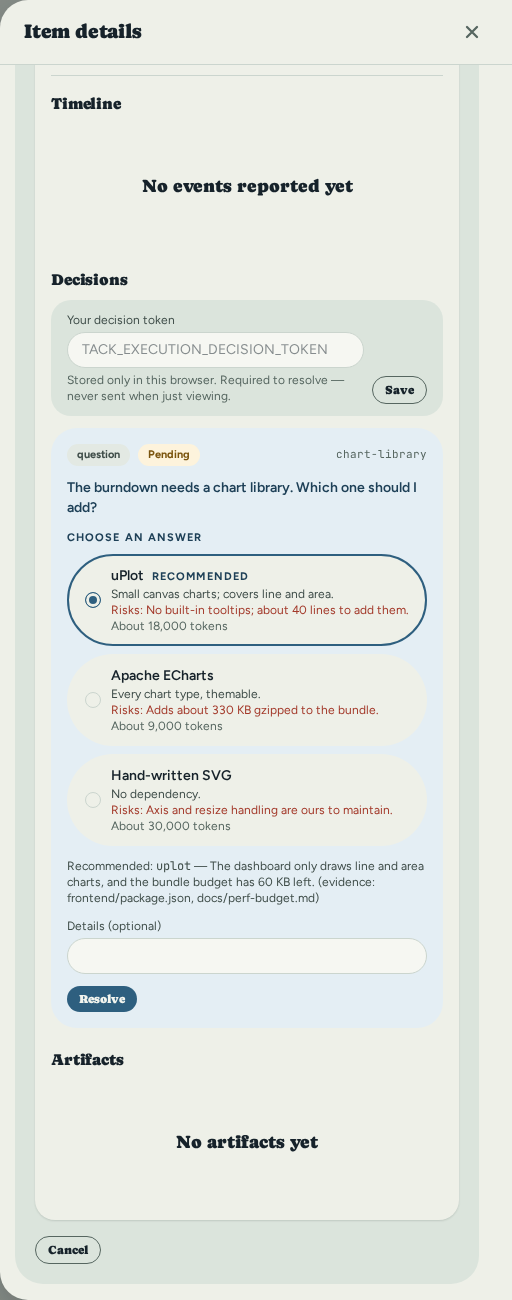
The question appears in the attempt's decision inbox, in the same item view as the run's
timeline and artifacts. Answering it needs TACK_EXECUTION_DECISION_TOKEN, a secret
separate from the ordinary API token. A question nobody answers before the attempt's
deadline is answered with its own deny option. It is never left open and never defaults
to allow.
Each question shows its kind, so a tool permission reads differently from a choice the agent wants you to make. An option can carry a short description, the risks of choosing it and a rough token cost. When the agent has a preferred answer, that option is preselected and marked Recommended, with the reason and any evidence beneath it; nothing is applied until you press Resolve, and you can pick any option. The first time someone opens a pending question, the board records that it was seen.
Checking a machine
Run tack runner doctor on the machine that will actually run the harness before
trusting anything above about your own install — it probes every harness this build has
an adapter for, with no runner enrollment and nothing written to the board. For each
harness it prints whether the binary was found and its version, one line on how it
authenticates, and whether it accepts an operator-chosen model verbatim
(model_passthrough) or only a declared list (model_combinations). Condensed from a
real run on a machine with all four installed:
codex
  status:      present
  version:     0.149.1
  credentials: Codex authenticates itself (its own CLI login, or an API key it reads
               from its own config)...
  model_combinations: (none reported)
  model_passthrough: supported — requested_model_id is forwarded verbatim via --model...

claude-code
  status:      present
  version:     2.1.273
  ...

docket
  status:      present
  version:     0.2.0b1
  ...

opencode
  status:      present
  version:     1.18.30
  ...

Runner-wide capabilities (apply identically to every harness above):
  cancel     advisory    — a process-group signal cannot reach a detached descendant unless the harness reports its process groups; see each harness's own cancel capability
  resume     unsupported — no resumable session contract
  decisions  supported   — at least one harness adapter opens a decision; see each harness's own decisions capability for which one
  artifacts  advisory    — uploaded when an adapter stages one; best-effort, not replayed on restart
  usage      advisory    — usage is reported only when a harness emits it

Secret store (resolves `secret_reference` environment entries):
  backend: keychain
  ...

Provider endpoint (vercel_ai_gateway):
  reaches: codex, claude-code, docket, opencode
  status:  not configured

Provider endpoint (anthropic):
  reaches: claude-code
  status:  not configured

verify: disabled
The last line reports the runner's verifier: disabled, or enabled with the program, whether
it was found on PATH, its arguments and its timeout. See
After a succeeded attempt.
A harness absent from your machine prints status: absent and names every directory it
searched, instead of the fields above — see
Where Tack looks for a harness binary below.
The runner-wide capabilities block is a single, deliberately conservative statement
that applies to every harness alike — it is not where claude-code's ability to pause and
ask shows up. decisions: supported here only means the protocol path exists on this
runner at all; which harness can actually use it is a per-harness fact, set by that
request's own permission_policy.approvals and recorded in the attempt's own capability
snapshot at claim time, not in this enrollment-time summary. Reading decisions: supported here does not mean every harness can pause; see the table above for which
one actually does.
How a provider's endpoint and credential are configured — the TACK_RUNNER_PROVIDER_*
variables, which secret-store entry each one reads, and the embedded runner's own key
field — is the single authority in docs/CONFIG.md, not restated here.
Running an item with an agent
There are four ways to turn a board item into an execution request. All four produce
the identical POST /api/executions record underneath — none is more "real" than
another. For a UI-only user the fastest path to a working setup is the Agents
page (/agents) first — turn execution on, confirm a harness is detected, paste a
provider key if you're using one, and choose a project default model — then the
"Run with agent" modal on any item, which reads that configuration back and needs
no hand-typed identifiers once it's done. The worked example below still uses the CLI,
because every field it sends is visible on the command line; see
Quick Start for the UI-first walkthrough.
| Entry point | Where | Notes |
|---|---|---|
| The "Run with agent" modal | Item detail drawer, web UI | Lays the run out top to bottom (see below), auto-selects the runner when exactly one is active, offers the target's own declared models plus "Project default", and blocks with a named reason (and, where one exists, a link to fix it) instead of submitting a request that would queue forever. |
tack execution create | CLI | Scriptable; every field the API accepts is a flag. Used for the worked example below. |
POST /api/executions | Raw HTTP | Same JSON body the CLI sends. See API Reference for a worked request/response pair. |
MCP create_execution | tack mcp, for an agent driving Tack itself | Same required fields as the REST call. See the MCP guide. |
The Run with agent dialog
The dialog reads as the whole flow, top to bottom, in four groups:
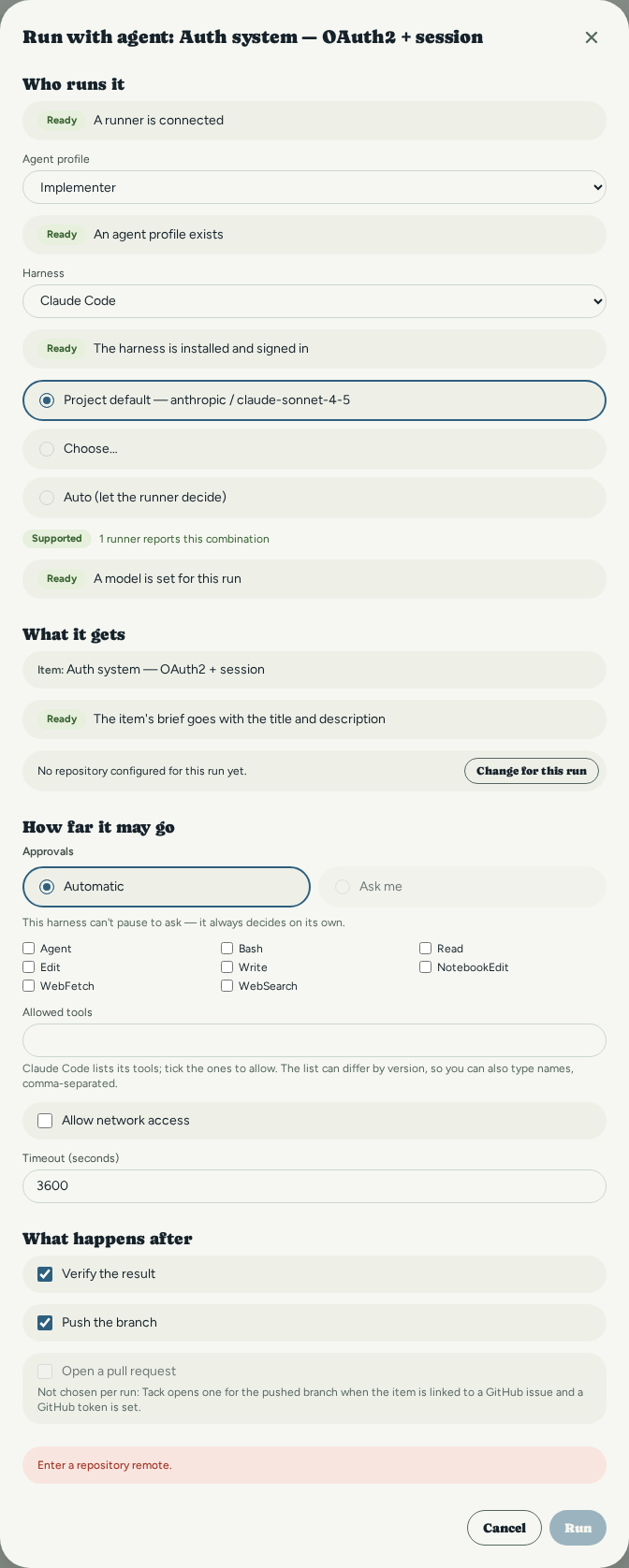
- Who runs it — the machine or group, the agent profile, the harness and the model.
- What it gets — the item, and its brief when it has one (an item without one says so and the agent gets its title and description), plus the repository to check out.
- How far it may go — approvals (Automatic or Ask me), the allowed tools, and the timeout. Claude Code's tools are offered as a checklist beside the free-text field; for codex, opencode and docket the field is free text, because none of them exposes a list of its tools.
- What happens after — Verify the result, Push the branch and Open a pull request.
A step that something is missing for shows a link to the page that fixes it (the Agents page for a runner, a harness or a model) and Run stays disabled until it is fixed. A step that is not available is never hidden: it is shown disabled with the reason beside it. "Ask me" is disabled for a harness that cannot pause to ask. Verify the result and Push the branch become checkboxes when the selected runner has a verifier or branch push turned on (see After a succeeded attempt); otherwise they are disabled and say which section of its TOML config turns them on. Unticking one declines it for this run only. Open a pull request is always disabled in the dialog: a pull request is opened for you once a pushed branch's item is linked to a GitHub issue, not chosen per run.
The rest of this section is one complete run through the CLI path, executed against a
real tack serve --with-runner with a stand-in claude binary standing in for a real,
authenticated install (so it costs nothing and never leaves the machine) — every id and
every line of output below is copied from that run, not constructed from the schema.
Swap the stand-in for a real, logged-in harness and the same commands reach the same
place against real work.
Before this: a project and an item exist (tack init, tack add), and either a
real enrolled runner is polling (see Enrolling a runner below) or
an embedded one is running (tack serve --with-runner — see
Standalone mode below). POST /api/executions requires all thirteen fields shown below; the CLI fills in an
idempotency_key (a fresh UUID) and empty objects for budgets/environment/metadata
if you omit them, so five of the thirteen are effectively optional in practice.
Create an agent profile — its instructions and limits are snapshotted into every request created against it:
tack agent-profile create "demo-profile" \
  --instructions "Print the single word DONE and exit. Do not modify any files."
Created agent profile: demo-profile (ap_91b4e)
  id: ap_91b4ea76-9f1a-4725-8a58-21a57d92572c
Find the runner to target. An embedded runner self-provisions under a name starting
local-; there is no tack runner list CLI subcommand today (see
Enrolling a runner), so read it back over the API:
curl -s http://127.0.0.1:3210/api/runners | jq -r '.data[].runner_id'
runr_8fa0dfb9-638f-492d-b278-ee06a789ad04
Now the full request, all thirteen required fields:
tack execution create <ITEM_ID> \
  --idempotency-key "release-notes-001" \
  --runner runr_8fa0dfb9-638f-492d-b278-ee06a789ad04 \
  --agent-profile ap_91b4ea76-9f1a-4725-8a58-21a57d92572c \
  --harness claude-code \
  --model-provider anthropic \
  --model-id claude-sonnet-4-5 \
  --agent-profile-snapshot '{"name":"demo-profile","instructions":"Print the single word DONE and exit. Do not modify any files.","tool_policy":{},"timeout_seconds":120,"budgets":{}}' \
  --repository '{"kind":"git","remote":"/path/to/local/repo","base_revision":"ce38796ef4f70db35eeb8d6d8b8e86477e1a883c","subdirectory":null}' \
  --permission-policy '{"tools":[],"network":false}' \
  --timeout-seconds 120
Created execution request: exec_0fe
  state: queued
  id:    exec_0fe7252989f5f3d40a056c1da45b035039e4a8247ad89e5222cf9280134ec5d1
Poll for the terminal state — a fresh embedded runner claims and completes an attempt against a stand-in harness in well under a second:
tack execution get exec_0fe7252989f5f3d40a056c1da45b035039e4a8247ad89e5222cf9280134ec5d1
Execution request exec_0fe7252989f5f3d40a056c1da45b035039e4a8247ad89e5222cf9280134ec5d1
  item:    e1d5e03d-4610-45c2-b5f1-835e69f148a7
  state:   succeeded (done)
  created: 2026-09-03T19:00:16.697646760+00:00
That is a completed attempt, reached with the commands above and no browser. For the
attempt-level detail tack execution get does not surface — fencing token, workspace
id, the staged artifact, the harness's own capability report at claim time — use
GET /api/executions/{request_id}/attempts:
curl -s http://127.0.0.1:3210/api/executions/exec_0fe7252989.../attempts | jq '.data[0]'
{
  "attempt_id": "att_fea7528f-853b-4c3c-a2d6-d1cf1b904e48",
  "state": "succeeded",
  "fencing_token": 1,
  "workspace_id": "ws_6174745f66656137353238662d383533622d346333632d613264362d643163663162393034653438",
  "actual_execution": {
    "harness_kind": "claude-code",
    "model_provider": "anthropic",
    "model_id": "unknown",
    "model_observation_source": "not_observed"
  },
  "terminal_reason": {
    "exit": "Exited(0)",
    "reason": "no structured result envelope was produced; inferred success from exit code 0",
    "artifact": { "kind": "log", "name": "claude-code-run.log", "size_bytes": 52 }
  }
}
Two things in that real output are worth reading closely rather than past: model_id
came back "unknown" with source not_observed — the stand-in binary used for this
page never echoes a model id the way a real harness does, and Tack reports that
honestly rather than assuming the requested id was actually the one that ran (the same
"not measured, never a fabricated value" rule as
usage economics, applied to model identity instead
of cost). And terminal_reason.reason came from an inferred exit code, not a
structured result — a real harness's own structured output, when it produces one, is
read instead; see What actually runs today.
Choosing a model and a provider
Two rules sit next to each other, on purpose, because conflating them is what causes
confusion: the board never holds a provider
credential — no TACK_* variable configures a vendor API key, and the API server
itself never proxies a model call (ADR 0050, ADR 0058) — and the runner can hold
one, on its own machine, in its own secret store, and use it to reach a model
provider on the board's behalf. The two statements are about different halves of the
product: see Local credential handling below and
docs/CONFIG.md's "Embedded runner" section, "Vendor/provider credentials" bullet, for
exactly where a credential may and may not live (ADR 0061 draws that line and bounds it).
Separately, and independently of where a credential lives, Tack routes the model
choice: which (provider, model_id) pair reaches the harness for a given request is
resolved server-side, deterministically, before the request is ever offered to a
runner. Routing a choice and holding a secret are different things — this section's
four-tier precedence below is the routing rule; the runner-side gateway path (the
fastest UI-only route to a working key) is in
Local credential handling.
The four-tier precedence
crates/tack-orch/src/model_policy resolves a request's model in this order, most
specific first, stopping at the first tier that has a value:
- Request override —
requested_model_provider/requested_model_idon the request itself (--model-provider/--model-idon the CLI, thePOST /api/executionsbody fields of the same name). Set by an explicit CLI flag, a raw API caller, or the modal's model picker when it isn't left on "Auto". - Agent-profile default — a
{"default_model": {"provider": "...", "model_id": "..."}}object inside the agent profile's ownlimitsfield (POST /api/agent-profiles --limits '...'ortack agent-profile create --limits '...'). Live-verified: creating a profile with this default and a request that omits--model-provider/--model-identirely still resolves and completes:
the resulting attempt'stack agent-profile create "sonnet-profile" \ --instructions "..." \ --limits '{"default_model":{"provider":"anthropic","model_id":"claude-sonnet-4-5"}}' # then tack execution create <item> --agent-profile ap_6e5649b8... --harness claude-code ... (no --model-provider/--model-id)actual_execution.model_providercame back"anthropic"— resolved server-side from the profile, never supplied on the request. - Project default —
projects.default_model(migration 062), the same{"default_model": {"provider": ..., "model_id": ...}}(or literal"auto") convention as the other tiers, set from the Agents page's "Default model" step orPATCH /api/projects/{id}.resolve_request_model_policyreads it as this tier — the only one with a settings UI at all, which is why the "Run with agent" modal's own submit gate points its "set a default model" fix link here (crates/tack-orch/src/model_policy/wiring.rs). - Fleet default — the same
{"default_model": {...}}convention, insideagent_fleets.default_policy(tack fleet create --policy '...'). Applies only to a request that targets the fleet itself (selector_kind: "fleet") — anexact_runner-targeted request never consults any fleet's policy, since it never names one. Live-verified the same way as tier 2: a fleet created with--policy '{"default_model":{"provider":"anthropic","model_id":"claude-opus-4-1"}}', a request targeting--fleet <that fleet>with an agent profile that has no default of its own, resolved toactual_execution.model_provider: "anthropic". - Auto-select — what happens when every tier above is empty. This is not a fallback that quietly picks something: see the next section.
All four tiers are resolved once, server-side, at request-creation time
(crates/tack-api/src/handlers/executions.rs, immediately before the request is
stored) — only when the caller supplied neither requested_model_provider nor
requested_model_id; an explicit pair (even a deliberately wrong one) is never
second-guessed by a lower tier.
Auto-select does not schedule today
Leaving every tier empty is a real, acceptable-looking state to reach — the modal's
model picker defaults to "Auto (let the runner decide)", and a request created that way
is accepted and stored as queued with no error. But no runner-v1 capability field
attests that a harness safely accepts an unspecified model, so the scheduler rejects
every candidate for an auto-select request with AutoSelectNotVerified
(crates/tack-orch/src/scheduler/select.rs) rather than guess. Live-verified: a
request created with requested_model_provider/requested_model_id both null and no
tier above resolving to a value stayed queued, with zero attempts, indefinitely — no
needs_operator, no error surfaced anywhere an operator would see it. The only fix
today is to supply an explicit model somewhere in the four tiers above; there is
currently no operator-visible signal that distinguishes a genuinely queued request from
one that can never be scheduled.
What a runner will actually accept
An explicit (provider, model_id) pair is eligible to schedule when either the target
harness's capability snapshot declares that exact pairing in model_combinations,
or the harness attests model_passthrough: supported (the adapter forwards the
operator's opaque model id verbatim and the harness validates it at its own run time).
model_passthrough: advisory is treated as unverified and rejected exactly like
unsupported — a capability claim below supported is not load-bearing
(crates/tack-orch/src/scheduler/select.rs). Run tack runner doctor on the actual
runner host to see this for real rather than trusting a stale copy of this page — the
full command and its unabridged output are in the CLI reference, and
what the rest of its output means is in
Choosing a harness. Condensed from a real run on a machine with
all four harnesses installed:
| Harness | model_combinations | model_passthrough |
|---|---|---|
codex | (none reported) | supported |
claude-code | (none reported) | supported |
docket | (none reported) | supported |
opencode | (none reported) | supported |
None of the four has a list-models command to probe, so every one declares zero
combinations and relies entirely on passthrough — any operator-specified model is accepted
pre-spawn and only the harness itself validates it at run time. A harness that can
enumerate its own installed/configured models would declare them instead and refuse
passthrough — rejecting an undeclared model before any process spawns rather than after
— but no adapter in this tree does that today.
Enrolling a runner
Enrollment is operator-initiated and two-step: the operator creates a pending runner and gets a one-time token; the runner (or whoever configures it) redeems that token.
tack runner enroll my-first-runner \
  --total-capacity 2 \
  --available-capacity 2
Enrolled runner: my-first-runner (runr_d91da686-...)
  token id:   ent_da7943b1-...
  expires at: 2026-08-19T16:17:51Z
  enrollment token: enr_57cd3592-...
  (shown once — copy it into the runner's TACK_RUNNER_ENROLLMENT_TOKEN now;
   it cannot be retrieved again)
The raw enrollment_token is generated by the server in this one response and is
never stored anywhere retrievable again — only its SHA-256 hash is kept
(crates/tack-api/src/handlers/runner_admin.rs). If you lose it, revoke the token
(tack runner revoke-token <runner-id> <token-id>) and enroll again. Pass --out <path> to write the response straight to an owner-only file instead of printing the
token to the terminal — useful when handing enrollment off to a provisioning script:
tack runner enroll ci-runner-1 --total-capacity 1 --available-capacity 1 \
  --out /secure/place/ci-runner-1.enrollment.json
Verified: tack runner enroll against a live server returns a runner_id,
token_id, and one-time enrollment_token, and a subsequent
GET /api/runners shows the runner in pending_enrollment state (there is no
tack runner list CLI subcommand today — only enroll/revoke/revoke-token; use
curl or the Agents page to list runners) — reproduced by hand for this page and
pinned by crates/tack-api/tests/handlers/production_router.rs and the runner-lifecycle handler tests
in crates/tack-api/src/handlers/runner_admin.rs.
Redeeming the token (the runner side)
The runner process exchanges the enrollment token for a durable credential the first time it starts:
export TACK_RUNNER_API_URL=https://tack.example.com/api/runner/v1
export TACK_RUNNER_ID=runr_d91da686-...
export TACK_RUNNER_STATE_DIR=/var/lib/tack-runner
export TACK_RUNNER_ENROLLMENT_TOKEN=enr_57cd3592-...
tack-runner
Prefer the environment variable over --enrollment-token: the flag exists but the CLI
help deliberately notes the env var keeps the secret out of shell history and process
listings. RunnerConfig::require_enrollment_credential() fails closed with a typed
error before any filesystem or network side effect if no credential is configured —
crates/tack-runner/src/config.rs.
Revoking a runner
tack runner revoke runr_d91da686-...
Revocation is immediate: the runner's hashed credential stops authenticating on the
next request. It does not retroactively invalidate an already-issued lease's fencing
token — a mid-flight attempt still needs the ordinary lease/lifecycle machinery (see
the recovery runbook) to reach a terminal or needs_operator
state. Revoke an unredeemed enrollment token without touching the runner record with
tack runner revoke-token <runner-id> <token-id>.
Standalone mode: tack serve --with-runner
Everything above assumes two processes: an operator running tack serve, and a
separate tack-runner process enrolled against it by hand. tack serve --with-runner
(or TACK_LOCAL_RUNNER_ENABLE=1) collapses that to one binary and one command — the
common case of one developer running an agent against their own board. It is off by
default; the full configuration reference (gate, state directory, provider-credential
story per harness) is docs/CONFIG.md, section "Embedded runner". This section covers
what changes about the enrollment/credential story above when you use it.
- Not a shortcut. The embedded runner runs as a task inside the server's own
process, but speaks runner-v1 over loopback HTTP exactly like a remote runner — the
same client, the same server-side path, the same contract fixtures. See
docs/adr/0058-standalone-single-binary-runner.md. - Zero-touch enrollment on a fresh state directory. The first start with no stored
session self-provisions: it creates its own pending-runner row and redeems its own
one-time token in-process. No
tack runner enrollcall is needed, and no token is ever printed, copied, or configured by hand. A second start against the same state directory reuses the stored credential on disk instead of provisioning a second runner — no second pending-runner row, no second token. - Loopback-only, refused before anything opens.
TACK_HOSTmust be a loopback address for--with-runnerto start at all; a non-loopback bind is refused as a startup error — before any socket or database is opened — never downgraded to a runner-less server. Verified bycrates/tack-cli/src/local_runner.rs'sembedded_runner_refuses_non_loopback_bindtest and, live, byscripts/smoke.shstep 12: a real attempt to bind non-loopback with--with-runnerexits non-zero naming "loopback", and no listener is ever opened on the refused port. - Off by default. Plain
tack serve— no flag, no environment variable — starts no runner at all. Verified live byscripts/smoke.shstep 11, which queriesGET /api/runnersdirectly after a settle window and finds it empty, not merely the absence of a log line. - Proven end to end.
scripts/smoke.shstep 10 drivestack serve --with-runneron a fresh state directory with no token, through self-provisioning, an active runner, and a real completed attempt, using the same fake-harness shim pattern the rest of the smoke script uses. - Log visibility. The embedded runner's own log lines are silent under default
logging (a pre-existing tracing-filter gap, not specific to this mode) — see
docs/CONFIG.md's "Embedded runner" section for the exactRUST_LOGsetting that surfaces them.
Everything else on this page — the capability matrix, workspace/artifact storage,
needs_operator recovery, version compatibility — applies identically whether the
runner is embedded or a separate process; the wire contract does not know the
difference.
Where Tack looks for a harness binary
The Agents page's "harness detected" check, and the runner's own startup probe, resolve
codex, claude, docket and opencode the same way: the runner process's own PATH
first, exactly as a shell would find it. If that search comes up empty, the runner then
checks a fixed list of
per-user install locations that a shell-launched terminal usually has on PATH but a
desktop launcher (a .desktop entry, Finder, the Start menu) or tack service under
systemd's user manager usually does not, since both start from a minimal session
PATH:
~/.local/bin~/.cargo/bin~/.bun/bin~/.npm-global/binand~/.npm/bin- every installed Node version's own bin directory under
~/.nvm/versions/node/ /opt/homebrew/binand/usr/local/bin(Homebrew)- on Windows,
%APPDATA%\npmand%LOCALAPPDATA%\nvm
This list is fixed, not configurable — there is no TACK_* variable for it. A machine
whose shell can already see the install is unaffected: PATH is always searched first,
and the first match wins. If neither search finds the binary, the reported error names
every directory it actually checked, so "not installed" always comes with a way to
confirm it — install the harness anywhere on that list, or make sure it is on the
PATH the runner process actually inherits.
Local credential handling
- The enrollment token is a bearer secret; the durable credential the runner receives after redeeming it is a second, longer-lived bearer secret. Both are hashed at rest — the server never stores either in a form it could hand back to you.
EnrollmentCredential'sDebugandDisplayimplementations are hardcoded to print[REDACTED]— this is structural, not a logging convention that a futureprintln!could bypass by accident (crates/tack-runner/src/config.rs).- The runner's on-disk state directory (
TACK_RUNNER_STATE_DIR, default.tack-runner) holds the attempt journal (below) and, since ADR 0061, a runner-local secret store for a configured provider's key — the platform keychain where one answers, an owner-only file otherwise, neverapp_metaor any other server-visible table. Set a value withtack runner secret set <name>(readsTACK_RUNNER_SECRET_VALUEor, failing that, stdin — never a CLI argument, which/procwould make world-readable), or, when the runner is embedded in the same process as the board (tack serve --with-runner), from the Agents page's own key field. A harness's own vendor login (Claude Max,codex login, ...) needs none of this — it is still the runner operator's own local environment, unmanaged by Tack either way. In every case, Tack's API and database never see, store, or forward a credential value — only the runner's own store resolves one, at spawn time, into the one subprocess that needs it. - Logs never carry the credential value. Redaction is tested with a positive control:
the redaction tests capture real
tracingoutput and assert the secret marker never appears and that an id does appear, ruling out "the capture rig just isn't observing anything."
Workspace and artifact storage
Each execution attempt gets one isolated workspace — a dedicated worktree, never
shared across attempts or requests (crates/tack-runner/src/workspace.rs). The
WorktreeProvisioner trait is the only boundary allowed to create it; tests inject a
fake so unit tests never touch a real git checkout.
On the runner side, before any harness process is allowed to start, an owner-only
journal record is written to TACK_RUNNER_STATE_DIR describing the workspace path and
base revision (crates/tack-runner/src/journal.rs). This durability-before-spawn
ordering is what makes crash recovery possible — see the
recovery runbook.
On the server side, verified artifacts a runner uploads (logs, diffs, generated
files — anything the harness produced worth keeping) are streamed to
<TACK_STORAGE_DIR>/execution-artifacts, a dedicated subtree kept apart from ordinary
item attachments (<TACK_STORAGE_DIR> itself) so the retention sweep documented below
can never touch the wrong directory
(crates/tack-api/src/router.rs, with_artifact_storage_root). Download is
GET /api/executions/{request_id}/attempts/{n}/artifacts/{artifact_id}/content, under
ordinary operator auth. GET .../attempts/{n}/artifacts and GET .../attempts/{n}/decisions
list what an attempt produced without a caller already knowing an id — the UI's
artifact panel and decision inbox both read these lists directly now.
Content integrity is checksum-verified end to end:
execution-attempt-detail.spec.ts uploads real content through a real runner
credential, computes its own sha256, downloads it back through the UI via a real
Playwright download event, and asserts the downloaded bytes equal the uploaded bytes
exactly.
Capability matrix
Every runner reports a capability snapshot at enrollment and refresh time —
protocol version, concurrency, installed harness versions, and per-feature support for
cancel, resume, decisions, artifacts, and usage, each as
unsupported | advisory | supported with an optional reason
(docs/contracts/runner-v1/capabilities.json). The scheduler and UI are required to
read this snapshot rather than assume a feature works.
The one enforced rule: an adapter may claim cancel: supported only if its harness
announces the process groups its shell tool starts. AdapterRegistry::register_probe rejects
any other probe that does, at registration time, before any attempt can reference it —
crates/tack-runner/src/harness/mod.rs, proved by
harness::tests::registering_a_probe_overclaiming_cancel_support_is_rejected. The reason is
structural: a harness's own shell tool spawns its subprocess in a new session outside the
runner's process group, so without being told the group the runner cannot promise it stopped
(confirmed with ps against each real harness installation; see each harness's own
fixtures/<kind>/README.md). Only docket announces its bash calls' process groups
(process_started / process_exited), and only when its negotiated contract is 1.1, so
cancel is supported for docket on 1.1 and advisory otherwise and for the other three
harnesses. On a cancellation the runner stops the main group, then sends SIGTERM and, after the
grace period, SIGKILL to each announced group still live. The cancellation evidence carries
details.groups as {tracked, killed, survived}. A harness that announces nothing always shows
tracked: 0, which means nothing was reported, not that nothing was left.
| Feature | Ceiling in this build | Why |
|---|---|---|
cancel | supported for docket on contract 1.1, advisory for everything else | Only a harness that announces its process groups can be held to stopping them — AdapterRegistry::register_probe rejects a stronger claim from any other, before any attempt can reference it |
resume | adapter-reported | No harness in this build declares a resumable session contract |
decisions | adapter-reported | Runner-driven bounded decisions (POST .../decisions) work when the harness supports them — claude-code, codex and opencode, and docket when the installed one accepts answers, and only when the request asks for it; see Asking before acting |
artifacts | supported for docket when it reports the files a run wrote, advisory otherwise | The other harnesses cannot guarantee artifact discovery; downgraded from an earlier supported claim |
usage | advisory | Token totals may be absent from harness output; see usage economics |
needs_operator and recovery
needs_operator is an explicit, non-automatically-retryable state for an attempt
whose ownership after a crash or network split cannot be proven safe. Tack never
blindly launches a second process against the same workspace. Full mechanics —
including exactly which recovery observations lead where — are in the
Recovery Runbook; the short version:
- A restarted runner reads its own journal and reports what it actually observed —
ProcessStopped,ProcessRunning, orAmbiguous(POST /api/runner/v1/attempts/{id}/recovery-observation). - The server computes a disposition:
SafePreSpawnRequeue(nothing had started yet — automatically safe),NeedsOperator(anything else), orAlreadyTerminal. - An operator resolves a
needs_operatorrequest explicitly, with an audited reason:
tack execution reconcile <request-id> \
  --recovery-key <key> \
  --reason "confirmed process was killed via ps on the runner host"
This calls POST /api/executions/{id}/requeue, which only succeeds for a request the
server itself authoritatively recovered — an unresolved or already-queued request
returns 409 invalid_transition with the current state named in details, never a
silent no-op. Verified by hand against a live server (an unresolvable request returns
{"code":"invalid_transition","details":{"from":"unknown","to":"queued"}}) and pinned
by crates/tack-cli/tests/e6_scheduler_e2e_test.rs.
Version compatibility
Every runner-v1 request body carries "protocol_version": 1. The server rejects
anything else outright — check_protocol_version in
crates/tack-api/src/handlers/runner_protocol.rs returns unsupported-protocol
(docs/contracts/runner-v1/errors/unsupported-protocol.json) for any value other than
the literal integer 1, on every one of the 13 runner-protocol operations. There is
no negotiated fallback: a v2 protocol, if it ever exists, is a new contract revision,
not a version range this server tries to interpolate.
Separately, each runner reports its own runner_version (a free-form string in the
capability snapshot) and each harness reports its installed_version — both are
informational, logged and stored, never used to gate behavior today.
Docket compatibility
Docket is reached the same way as any other coding agent: as a harness
(--harness docket) on a runner-v1 execution request, through the API and
CLI surface described on this page — see Choosing a harness for
what it needs installed and what it can and can't do. The earlier, separate Docket
control-plane bridge — a standing background poller with its own dispatch,
approval and budget routes — has been retired; Docket carries no special
scheduling path or API surface of its own anymore.
Non-loopback and security posture
Runner-protocol routes (/api/runner/v1/*) are mounted as a structural sibling of
the operator /api router, not nested inside it — they never traverse
require_token (the operator bearer-token gate) at all, and each handler
authenticates its own hashed runner credential independently
(crates/tack-api/src/handlers/runner_protocol/runner_auth.rs). This is deliberate:
a future edit that widens the operator auth exemption list cannot accidentally loosen
runner auth, because runner auth was never implemented as an exemption in the first
place.
For everything else about exposing Tack beyond 127.0.0.1 — TLS termination behind a
reverse proxy, TACK_ALLOWED_ORIGINS, TACK_API_TOKEN, request body limits — see
Administration and Security, which applies identically whether or
not any runner is enrolled. The one addition specific to this domain:
TACK_EXECUTION_DECISION_TOKEN is a separate, higher-privilege secret layered on
top of TACK_API_TOKEN, fail-closed when unset (the route rejects rather than silently
falling back to the ordinary operator token) and never logged. See docs/CONFIG.md for every TACK_* variable in this
domain.
tack serve --with-runner (see "Standalone mode" above) adds a second, stricter
loopback requirement on top of all of this: an embedded runner executes arbitrary
coding-agent processes on the same host serving the UI, so --with-runner itself
refuses to start unless TACK_HOST is a loopback address — independent of, and checked
before, whichever TACK_API_TOKEN/TACK_API_ALLOW_UNAUTHENTICATED_NONLOOPBACK posture
the server would otherwise apply.
After a succeeded attempt
What a runner does once an attempt has succeeded, and before its workspace is deleted. Every
step below is the runner's, on its machine; the board never runs a program or pushes a branch.
None of them can change the attempt's outcome: if one fails, the attempt is still succeeded and
the failure is recorded as an event on its timeline.
Evidence. For every harness, and also for a cancelled attempt, the runner records what the
attempt changed against the revision it started from. Three artifacts are uploaded:
changes.patch (the full diff, cut at 8 MiB with a flag in the manifest when it is longer),
files.json (each path and whether it was added, modified, deleted or renamed) and
evidence.json (the manifest: the base and head commits, the patch's checksum and size, the
files, the terminal reason and the usage). When the request carried a brief, brief.json is
kept beside them. If git cannot read the workspace, only evidence.json is written and it says
why. The shape is docs/contracts/evidence-v1/.
Verification. A runner with a [verify] section enabled in its TOML config runs a program
of yours over that evidence and uploads the merge-readiness pack it writes as one more artifact.
It is off by default. A failing, missing or timed-out verifier records attempt.verify_failed
and nothing more. The pack is what you read under
Reviewing a merge-readiness pack. The section is described in
docs/CONFIG.md; tack runner doctor reports whether it is on and whether the program is found.
Branch push. A runner with push_branches = true under [git] commits what the harness left
uncommitted onto a branch named <prefix><item short id>-a<attempt number> and pushes it to the
remote the repository was fetched from, using your own git credentials. It is off by default. A
failed push records attempt.push_failed. Turn it on only for agents you would trust with those
credentials; docs/CONFIG.md says what the push does and does not guard against.
Pull request. When the attempt pushed a branch, its item is linked to a GitHub issue and a GitHub token is configured, the server opens a pull request from that branch, with the merge-readiness pack as its body. The attempt then shows a PR #n link and a badge: open, merged, closed or reverted. The state follows GitHub on the sync poll; see GitHub sync. An item with no link, or no token, gets no pull request and nothing else changes.
Moving the item. A request can carry a status policy: done_on_success moves the item to
its workflow's first Done status when the attempt succeeds, and done_on_mrp_accepted moves it
when you accept the attempt's merge-readiness pack. Without one the item's status is never
touched. Set it with tack execution create --status-map-policy or status_map_policy_id in the
API and MCP; the Run with agent dialog does not offer it. The move goes through the workflow's
ordinary rules and open boards are told, like any edit.
Reviewing a merge-readiness pack
When a verifier checks an attempt, it leaves a merge-readiness pack. Open the attempt's details on the Execution tab and the pack appears under "Merge-readiness pack".
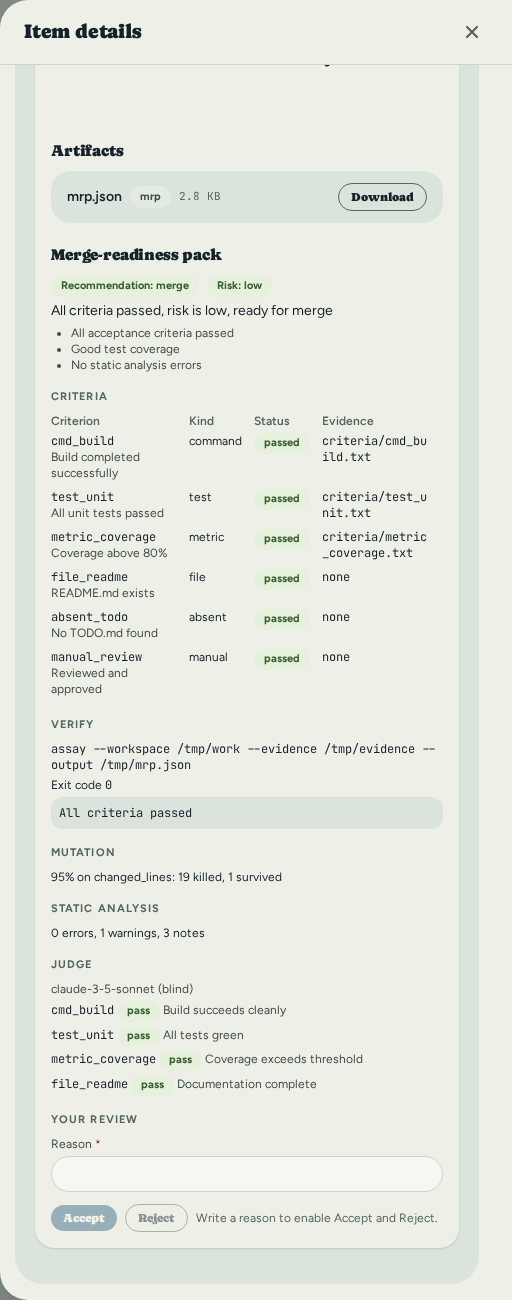
From top to bottom it shows the verifier's recommendation and the risk level with its reasons, then one row per criterion from the brief (id, kind, status, evidence), the verify command with its exit code and output, mutation results, static-analysis counts and the judge's verdict on each criterion.
A section the verifier did not run says Not run. That is not a pass: nothing was checked.
To record your verdict, write a reason, then choose Accept or Reject. Both stay
disabled until the reason has text. The first review is final; a second one is refused.
If the run was created with the done_on_mrp_accepted status policy, accepting also moves
the item to its workflow's first Done status.
Usage economics and "Not measured"
usage_economics.runner_time_cost.cost_usd_estimated is always
{value: null, source: "not_measured"} in production — no runner infra cost-rate is
stored anywhere in this schema, so there is nothing honest to compute it from. The UI
renders the literal string Not measured, never $0.00: rendering zero would claim
the run was free, which is not known to be true.
attemptFormat.test.ts#formatUsdMeasurement asserts the exact string, that it does
not contain $0, and — as a positive control — that a real
{value: 0, source: "measured"} renders the genuinely different "$0.00 (measured)",
proving the two cases are distinguished rather than both collapsing to one string.
Token usage, when the harness reports it, is measured. When it doesn't, it is
not_measured — never a structural zero standing in for "unknown."
Factory metrics
The Factory metrics page (Factory metrics in the project's sidebar, at
/projects/<id>/factory; GET /api/projects/{id}/metrics/factory for the same numbers) shows one card per metric from an aggregated summary of all
attempts, decisions, and verification activity for a project. The page covers all time; the endpoint takes an optional since
(RFC 3339) to start the window later. Each card displays the
computed ratio or value (when it can be measured), or "Not measured" with its reason when
measurement is not possible.
| Metric | Definition | Source |
|---|---|---|
| Escalation rate | Decisions ÷ Attempts | execution_decisions ÷ execution_attempts in the window |
| Human minutes per decision | Median and p90 of the time a decision waits for an answer | From when someone first opened the decision (or from when it was raised, if nobody opened it first) to its resolution; execution_decisions in the window |
| Human minutes per pack review | Median and p90 of the time a merge-readiness pack waits for its verdict | From when someone first opened the pack (or from when it was uploaded, if nobody opened it before the verdict) to the review; mrp_reviews in the window |
| Verification tax (tokens) | (Verification + Rework) ÷ Implementation | Implementation = tokens from each request's first attempt; Rework = tokens from later attempts plus requests marked as rework; Verification = the tokens each verifier reported spending in its pack |
| Pack acceptance rate | Accepted ÷ Reviewed | Counts from mrp_reviews; also shows unreviewed and produced packs |
| Outcomes | Pull requests opened, merged, closed, reverted | Data from pull_requests; also shows PQC (pull request quality: merged and not reverted) |
When a metric has nothing to count, the card says "Not measured" and why, never 0. No
card shows money: token counts only. When timing data has no resolved samples in the window, it shows "Not
measured" rather than zero minutes. The source column for each metric shows which table
it reads and, for time-based metrics, whether resolution time started from viewed_at
(human first opened it) or created_at (never viewed before resolution).
Known gaps
These are documented rather than papered over, per this project's "unsupported is typed, unknown is explicit" rule:
execution_requestshas no realprioritycolumn. Ametadata-convention stopgap exists, documented as non-binding.- A docket run that times out is not cancelled. Cancelling stops every process group docket announced; a timeout stops only docket's main process group, so a command docket started in its own group can outlive the attempt.
tack runner doctordoes not print each harness'sartifactsandpermission_policysupport in its readable output; for docket those are decided when the runner starts.- The branch push runs git in the attempt's workspace, which the agent could have
reconfigured while it worked. Hooks are disabled; see
docs/CONFIG.md.
What actually runs today
Read this section before treating any earlier claim on this page as a promise about a live, end-to-end run.
Proven end-to-end against the real production router (build_router, no
card-local test scaffolding): creating an execution request, scheduling it to an exact
runner or a fleet, the full runner-v1 protocol surface (enroll → claim → heartbeat →
accept → start → events → decisions → artifacts → completion), cancellation and
recovery-observation handling, the decision-resolve and artifact-download routes, and
the retention/expiry sweeps — see crates/tack-api/tests/handlers/production_router.rs,
crates/tack-orch/tests/runner_contract.rs (byte-pins all 46 frozen fixtures), and the
integrator test files referenced throughout this page.
The tack-runner binary's own network transport is wired and proven.
tack_runner::bootstrap::build_runtime (the one composition root both the standalone
tack-runner binary and the embedded
tack serve --with-runner/tack runner start paths call — see "Standalone mode"
above) wires the real HttpPullProtocol, not UnavailableProtocolClient.
UnavailableProtocolClient still exists in the crate as an explicit no-client
fallback — reachable only if something constructs a runtime without attaching a
protocol client — and stays pinned by
runtime::tests::unavailable_protocol_is_a_typed_failure_not_success precisely so that
path fails as a typed RunnerError::ProtocolUnavailable rather than a silent success;
it is not what a real tack-runner startup wires today.
Live, end-to-end proof of the real client: crates/tack-runner/tests/ bootstrap_entrypoint.rs proves the composition root itself is reachable and
shutdown-controllable from outside the crate against a real (mocked) HTTP enrollment
exchange. Every run of scripts/smoke.sh exercises the real client against a real
server: steps 6-9 enroll a separate tack-runner process and drive a real attempt
through claim → checkout → harness → completion, restart recovery included; step 10
does the same inside a single tack serve --with-runner process. A fresh-machine
operator today can enroll a runner and point a real tack-runner process (standalone
or embedded) at a real server and watch it enroll, claim, and complete real work.