Fine-tuning, proven — a real run end to end
This page is not a mock-up. Every screenshot below comes from a real fine-tune that trained on a GPU, was scored on examples it never saw, passed the quality gate, and then served live answers — captured straight from the operator console.
The task: route inbound support tickets into one of three buckets —
billing, technical, or account. A small, concrete behavior: read a
message, reply with one label. Exactly what fine-tuning is good at (and what a
generic model does poorly out of the box).
What you're looking at
Base model qwen2.5-0.5b-instruct (the smallest in the catalog), trained on 36 real example tickets. If even the smallest model clears the gate on this, a larger one clears it by more. This is the floor, not the ceiling.
The whole pipeline at a glance
Dataset → training job → eval gate → serving. One project, four steps, all green:
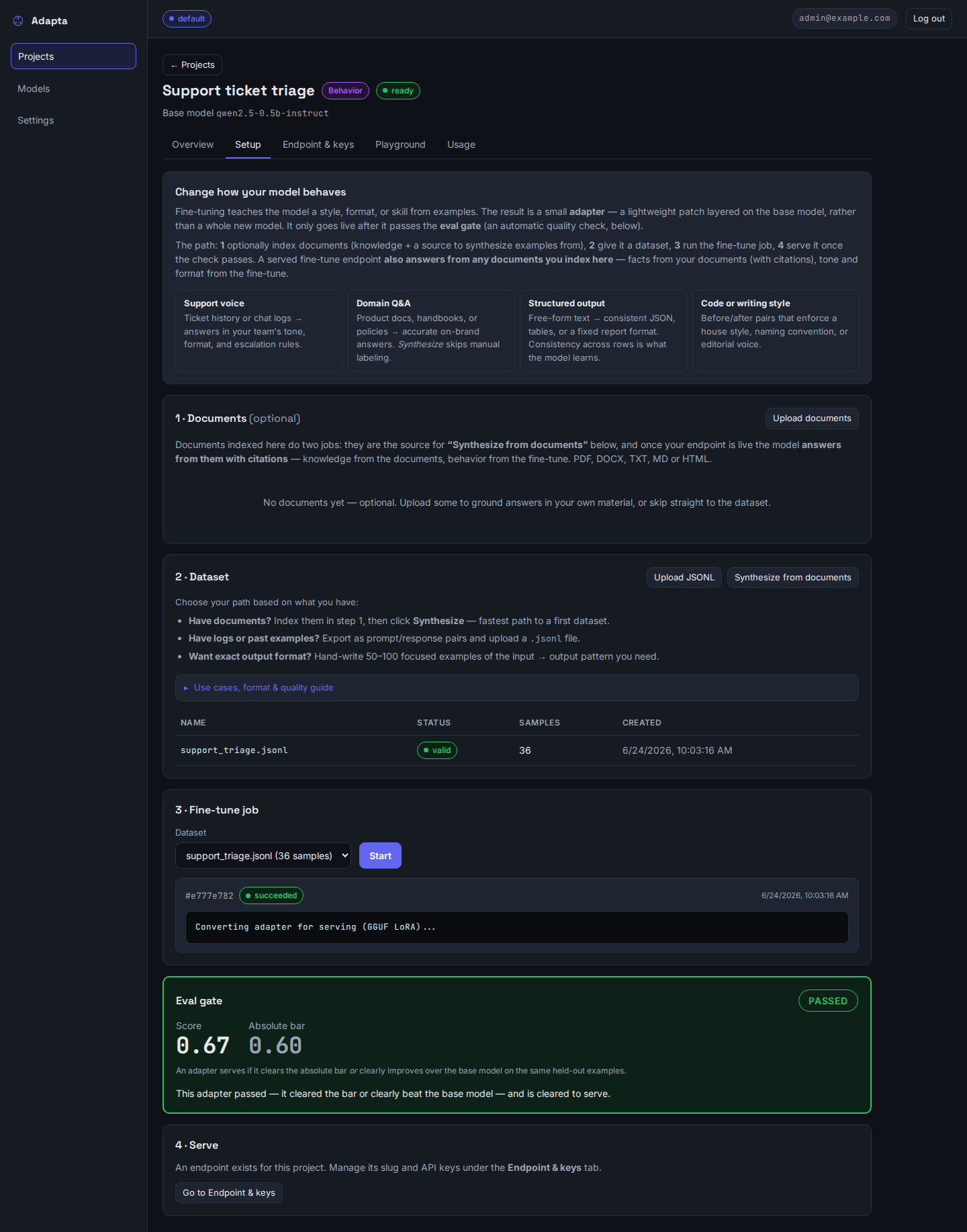
The platform never calls this "training" in the textbook sense — the console frames it as "change how your model behaves." The steps below walk through what matters.
1 · The dataset and the training job
A dataset is just example pairs: an input (the ticket) and the ideal output (the
label). 36 of them, uploaded as a .jsonl file. The job then runs QLoRA on the
GPU — it produces a small adapter (a few MB) that layers on top of the base model
without changing it.
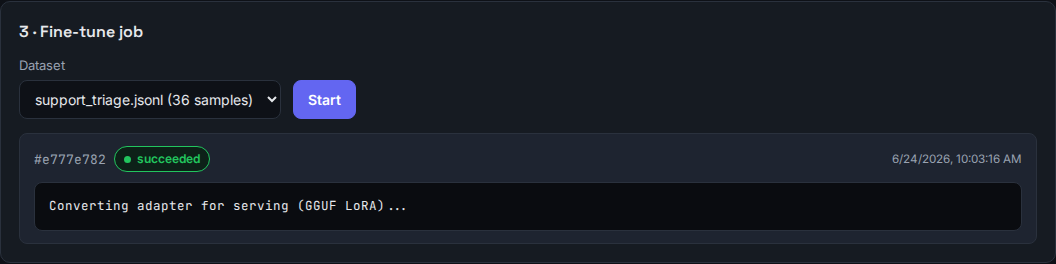
The job is green — succeeded. But "the training finished" is not the same as "the result is good." That's what the next step decides.
2 · The eval gate — the part that matters
Before an adapter is ever allowed to serve, it sits an exam on examples held out from training (the model never saw them). This is the platform's core safety guarantee: an unproven fine-tune cannot go live.

Reading this card in plain terms:
- Score 0.67 — how well the adapter produced the right label on the held-out
tickets. Higher is better;
1.0would be perfect. - Absolute bar 0.60 — a high bar meaning "strong on its own." This run cleared it (0.67 ≥ 0.60).
- There's also a second way to pass — beating the base model by a clear margin on the same held-out tickets (here it also did: +0.099 over base). Either path earns a PASSED. A fine-tune that learned nothing useful clears neither and is blocked — it simply cannot be served.
This is the honest signal. It is not a participation trophy: in our test suite, a deliberately patternless dataset is correctly rejected by this same gate.
3 · It becomes a live, OpenAI-compatible endpoint
Because the gate passed, the project can mint a serving endpoint — a normal
OpenAI-style API. Point any OpenAI client at it, use the slug as the model, and
authenticate with a scoped adp_ key.
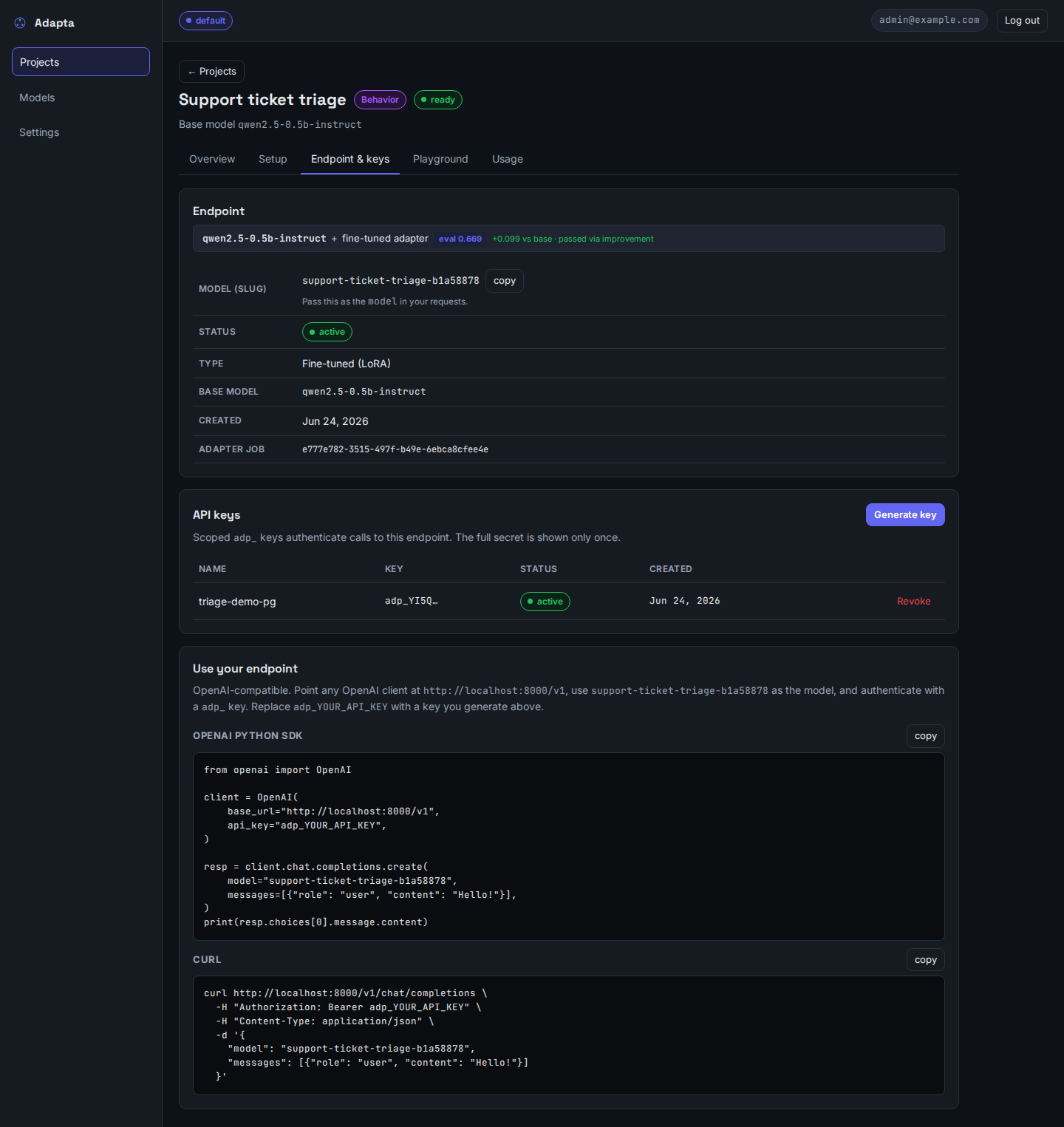
Notice the header: qwen2.5-0.5b-instruct + fine-tuned adapter · eval 0.669 ·
passed via improvement. The endpoint is the base model plus the proven adapter,
nothing hand-wired.
4 · The proof: it actually answers with what it learned
The console Playground calls that exact endpoint with a ticket the model never trained on:
My card was declined but I was still charged — what happened?
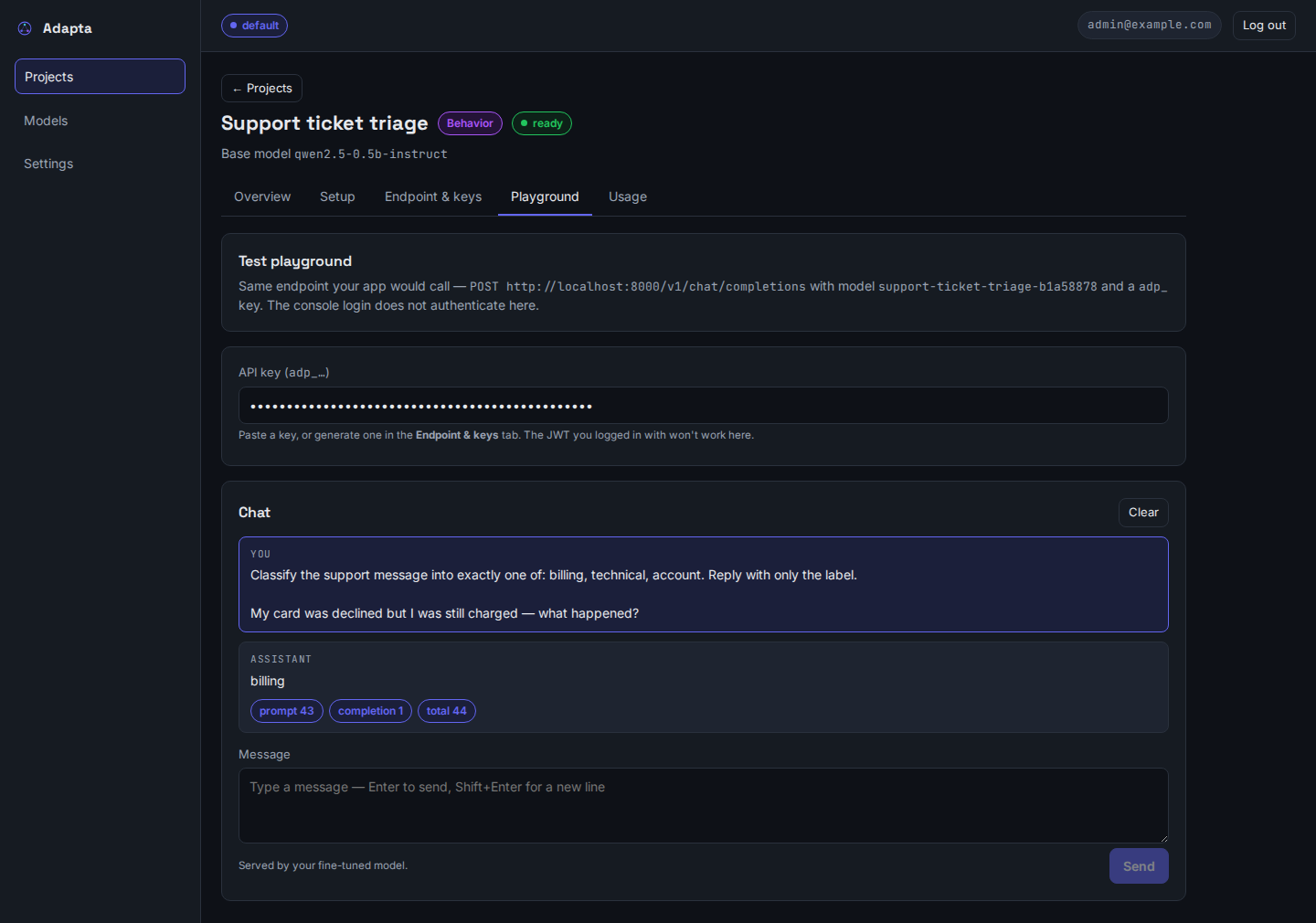
The answer is a single word: billing. The un-adapted base model, given the same
prompt, rambles a paragraph of guesses — measured against the same held-out set,
which is why the improvement over base is real. The fine-tune learned to do one job and do it
cleanly.
What this run demonstrates
- The pipeline is real and complete — upload, train on GPU, score on held-out data, gate, convert, serve. No step is faked.
- The gate works in both directions — it passed a genuinely useful adapter and (in the test suite) blocks a useless one.
- Fine-tuning shines on a bounded behavior — classification here; the same holds for structured extraction (text → fixed JSON) and fixed format/voice. For facts, use Knowledge (RAG) instead — and you can combine both on one endpoint.
Reproduce it yourself
The viability of each use case is pinned by an automated, GPU-backed test:
tests/integration/test_lora_use_cases.py (run with ADAPTA_RUN_LORA_USECASES=1).
It trains extraction, classification and format adapters, asserts each clears the
gate, and asserts an unlearnable control dataset is blocked.