Knowledge + behavior — using RAG and fine-tuning together¶
The two services answer two different questions:
- Knowledge (RAG) changes what the model can talk about — it answers from your documents, with citations. No weights change.
- Fine-tuning (LoRA) changes how the model behaves — its tone, its output structure, a narrow skill. It does not reliably add facts.
The strongest production pattern uses both on one endpoint: retrieval supplies the facts, the adapter makes the answer come out in your voice and your format. This page explains when to use which, and walks one realistic example end to end.
When to use which — real-life cases¶
| Your situation | Use | Why |
|---|---|---|
| "Answer questions about our 400-page product manuals" | Knowledge | The facts live in documents; they change when the docs change — re-index, done. |
| "Our internal wiki updates weekly and answers must cite the source" | Knowledge | RAG citations point at the exact passage; updates are instant. |
| "Support replies must always follow our 5-part template and sound like us" | Fine-tuning | A format/voice is a behavior — it lives in weights, not in any document. |
| "Classify incoming tickets into our 12 internal categories" | Fine-tuning | A narrow skill with your private taxonomy; small local models learn it well from examples. |
| "Always answer in strict JSON our backend parses" | Fine-tuning | Prompting drifts; a fine-tune makes the structure near-deterministic. |
| "A support assistant that answers from our manuals, in our voice and template" | Both | Facts from retrieval (cited), form from the adapter. |
What fine-tuning is not for
Don't fine-tune to teach the model facts ("memorize our price list"). Facts belong in documents the model retrieves — they stay current and come back cited. A fine-tune that tries to memorize facts is brittle and goes stale on the first product change. Rule of thumb: facts → Knowledge, form → Fine-tuning.
How the combination works¶
A project of type fine-tune can also index documents (console: the
Documents step of the fine-tune flow; API: the same
POST /v1/projects/{id}/files used by RAG projects). At serve time the
endpoint composes whatever the project has:
- documents indexed → relevant passages are retrieved and injected, and the
response carries
citations; - an eval-passed adapter → it is applied on top of the base model.
A fine-tune project with indexed documents gets both in the same call.
(A pure-RAG project and a documents-free fine-tune project behave exactly as
before.) Bonus: those same indexed documents are what
POST …/datasets/synthesize reads when you bootstrap a dataset from documents.
How retrieval works — hybrid vector + BM25
Retrieval is hybrid by default: a dense vector search (sentence-transformers
embeddings) and a sparse keyword search (BM25) run in parallel; their
ranked lists are merged via Reciprocal Rank Fusion (RRF). A cross-encoder
reranker then re-scores the fused candidates before the top-k are injected.
The result is more accurate than pure vector search on keyword-heavy queries
(product codes, names, exact phrases) and more robust than pure BM25 on
paraphrase-style questions. No configuration is needed — this is always on.
To disable the reranker (lower latency, slightly lower accuracy), set
ADAPTA_RAG_RERANKER_MODEL="" in the worker environment.
Worked example — a support assistant for "Nordwind Appliances"¶
Nordwind sells industrial coffee machines. They want an assistant that:
- answers from the official service manuals (facts → documents),
- always replies in the house template — acknowledge → likely cause → numbered steps → safety note → sign-off — in a calm, no-marketing tone (form → fine-tune).
Everything below also works through the console (the fine-tune flow is the same four steps); the API calls are shown so you can script it.
1 · Log in and create one fine-tune project¶
TOKEN=$(curl -s localhost:8000/v1/auth/login \
  -H 'Content-Type: application/json' \
  -d '{"email": "admin@example.com", "password": "admin12345"}' | jq -r .access_token)

TEAM_ID=$(curl -s localhost:8000/v1/auth/me -H "Authorization: Bearer $TOKEN" \
  | jq -r '.teams[0].team_id')

PROJECT_ID=$(curl -s localhost:8000/v1/projects \
  -H "Authorization: Bearer $TOKEN" -H 'Content-Type: application/json' \
  -d "{\"name\": \"Support assistant\", \"type\": \"finetune\",
       \"base_model\": \"qwen2.5-3b-instruct\", \"team_id\": \"$TEAM_ID\"}" | jq -r .id)
One project, type finetune — it will hold the documents and the adapter.
2 · Give it knowledge: upload the manuals¶
curl -s localhost:8000/v1/projects/$PROJECT_ID/files \
  -H "Authorization: Bearer $TOKEN" \
  -F file=@espressomat-9000-service-manual.pdf
Upload each manual (PDF, DOCX, TXT, MD, HTML). Indexing runs in the
background; GET …/files shows indexed with a chunk count when done.
3 · Teach it the behavior: the dataset¶
The dataset teaches the template and tone, not the facts — the facts will come from retrieval at serve time. Write (or export from your ticket system) prompt/response pairs where every response follows the house template:
{"prompt": "The grinder makes a loud rattling noise.", "response": "Thanks for flagging this — a rattling grinder is worth stopping for.\n\nLikely cause: a foreign object (often a stray bean stone) in the burr chamber.\n\nSteps:\n1. Power the machine off and unplug it.\n2. Remove the hopper and empty the burr chamber.\n3. Inspect the burrs for debris and wear.\n4. Refit and run a 10 g test grind.\n\nSafety note: never open the burr chamber while the machine is plugged in.\n\n— Nordwind Support", "system": "You are Nordwind Appliances support. Always answer with: acknowledgment, likely cause, numbered steps, a safety note, and the team sign-off."}
Aim for 50–500 pairs, one consistent template throughout — the model learns the pattern. At least 10 valid rows are required (the last ~20% is held out to score the result and never trained on). Upload it:
DATASET_ID=$(curl -s localhost:8000/v1/projects/$PROJECT_ID/datasets \
  -H "Authorization: Bearer $TOKEN" -F file=@support-style.jsonl | jq -r .id)
Bootstrapping from the manuals
POST /v1/projects/{id}/datasets/synthesize drafts Q/A pairs from the
documents you indexed in step 2 — a fast start, but it produces generic
Q/A. For a tone/template fine-tune, reshape the synthesized answers into
your template (or hand-write the gold examples) before training: the model
copies what it sees.
4 · Train, pass the gate, serve¶
JOB_ID=$(curl -s localhost:8000/v1/projects/$PROJECT_ID/jobs \
  -H "Authorization: Bearer $TOKEN" -H 'Content-Type: application/json' \
  -d "{\"dataset_id\": \"$DATASET_ID\"}" | jq -r .id)

# poll until succeeded; eval_passed must be true
curl -s localhost:8000/v1/projects/$PROJECT_ID/jobs/$JOB_ID -H "Authorization: Bearer $TOKEN"
The job trains a LoRA adapter on the GPU worker and scores it on held-out examples. It may serve only if it clears the absolute score bar or clearly improves over the base model on the same held-out split — an unverified fine-tune never goes live. Then:
SLUG=$(curl -s -X POST localhost:8000/v1/projects/$PROJECT_ID/endpoint \
  -H "Authorization: Bearer $TOKEN" | jq -r .slug)

KEY=$(curl -s localhost:8000/v1/projects/$PROJECT_ID/keys \
  -H "Authorization: Bearer $TOKEN" -H 'Content-Type: application/json' \
  -d '{"name": "support-app"}' | jq -r .key)   # adp_… — shown once
5 · Call it — facts and form in one answer¶
Any OpenAI client works:
from openai import OpenAI

client = OpenAI(base_url="http://localhost:8000/v1", api_key=KEY)

r = client.chat.completions.create(
    model=SLUG,  # the endpoint slug from step 4
    messages=[{"role": "user",
               "content": "The Espressomat 9000 shows error E-42, what do I do?"}],
)
print(r.choices[0].message.content)
What happens inside the one call: the question is embedded, the most relevant
manual passages are retrieved and injected (knowledge), and the adapter
shapes the reply into the acknowledged → cause → steps → safety → sign-off
template (behavior). The raw HTTP response also carries citations
pointing at the manual passages used, so your app can show "source: service
manual §4.2".
See it working — one endpoint, knowledge + behavior¶
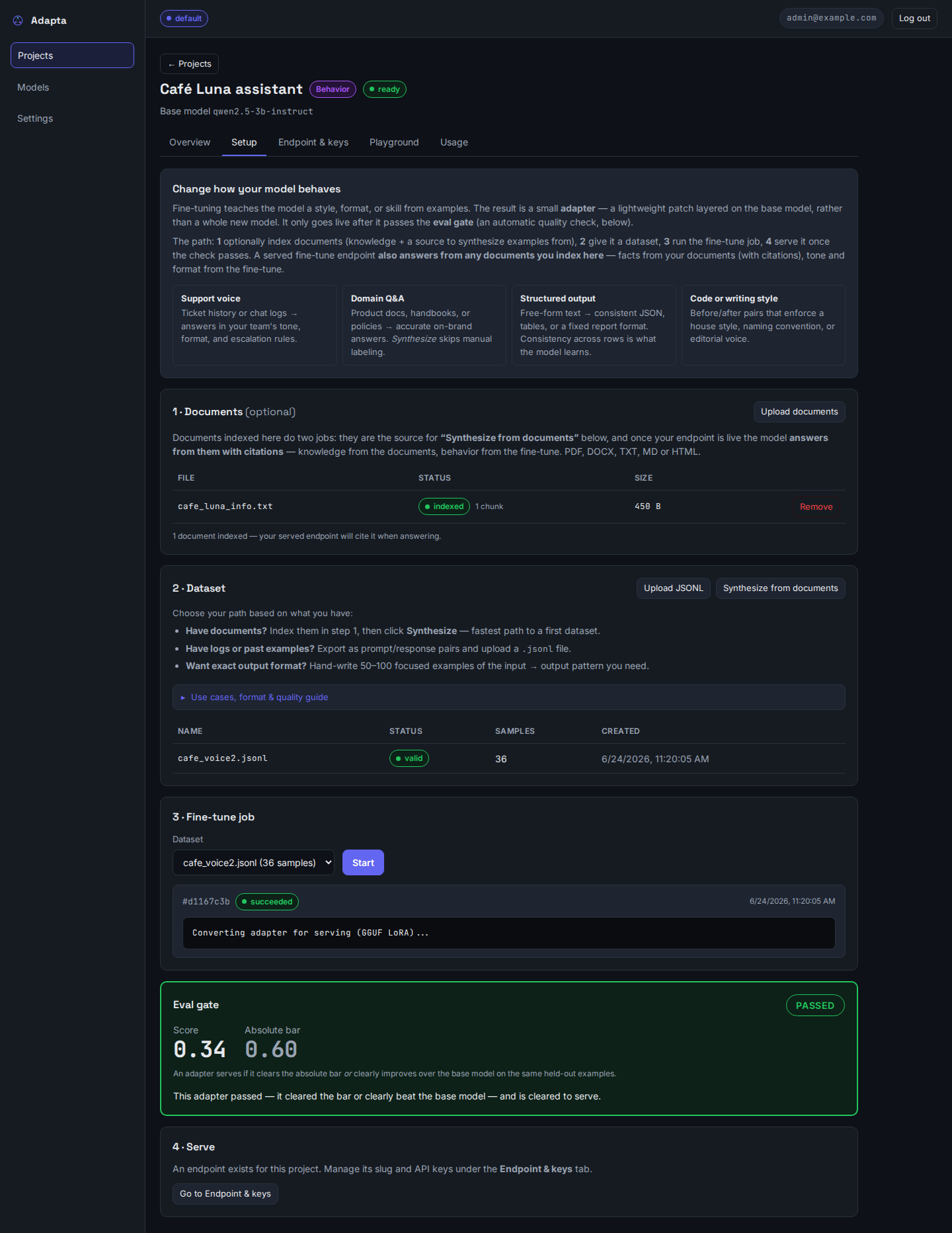
These screenshots are from a real run, not a mock-up: a corner coffee-shop assistant, Café Luna. One fine-tune project holds both an indexed info sheet (the café's hours, Wi-Fi, loyalty program → knowledge) and a fine-tune trained on the café's friendly brand voice (behavior), trained on the GPU and gated before serving.
One project, both inputs — a document indexed and an adapter that passed the eval gate:
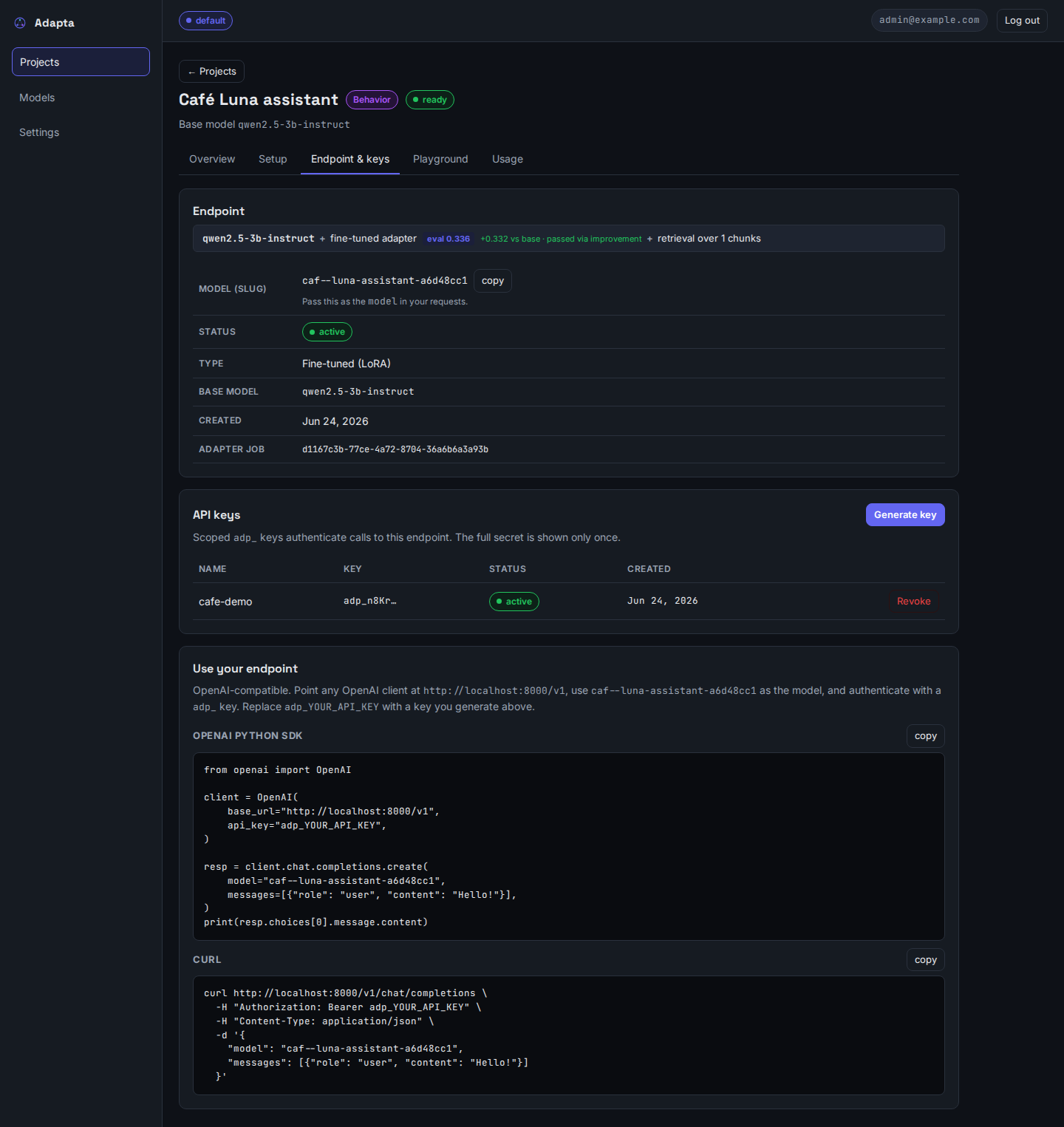
The endpoint header spells out the composition in one line —
base + fine-tuned adapter · eval 0.336 · passed via improvement + retrieval over 1 chunks:
The payoff — the Playground sends "Can I bring my dog?" and gets one answer that is grounded in the document and in the trained voice:
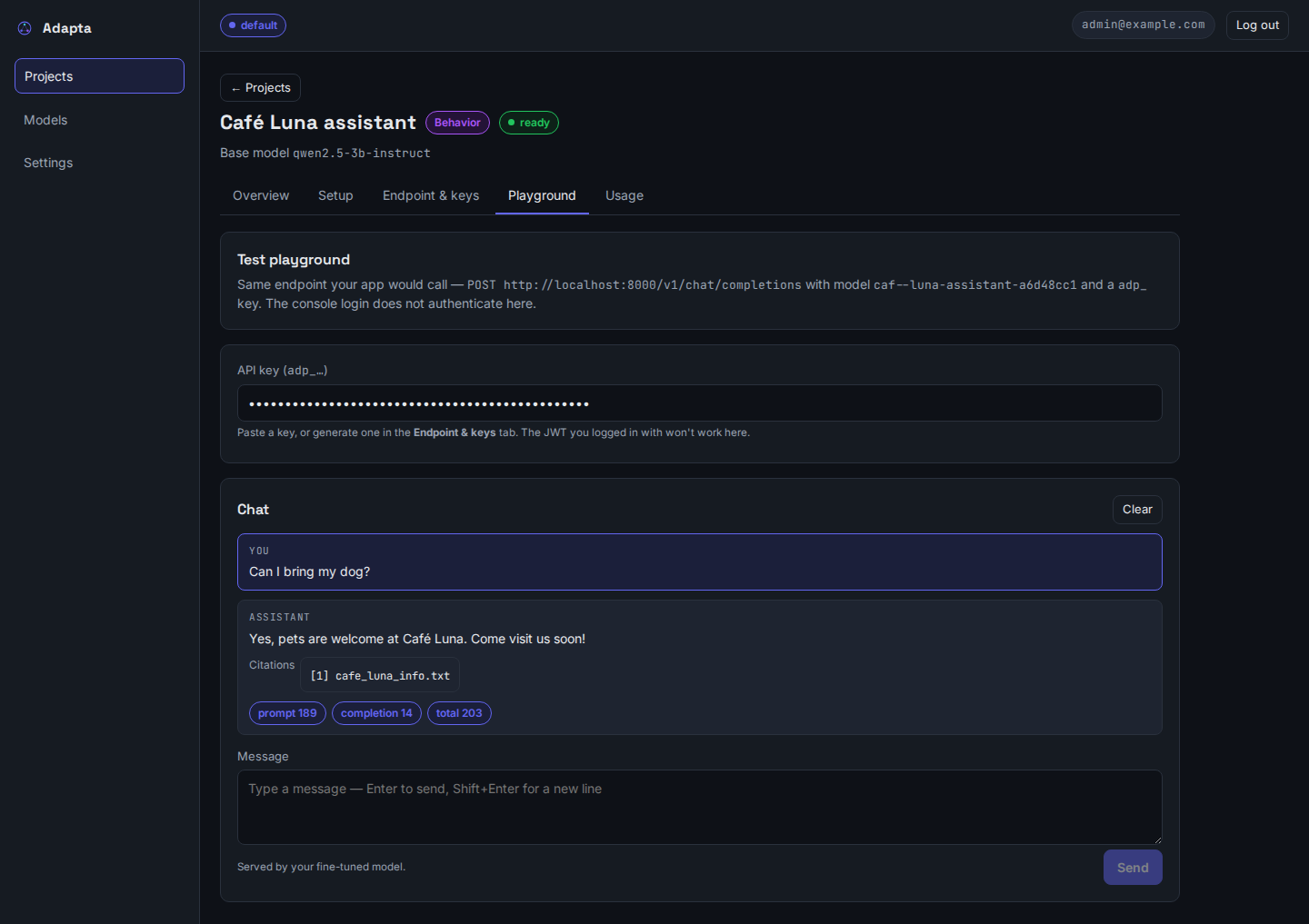
The fact (pets are welcome) is pulled from the indexed sheet — note the
[1] cafe_luna_info.txt citation — while the "Come visit us soon!"
sign-off is the fine-tune. Facts from retrieval, voice from the adapter, one call.
A real composition nuance — how RAG and voice share an answer
When documents are retrieved, the endpoint adds an instruction to answer from the context and cite sources. On smaller base models, a very rigid style signature (a fixed multi-sentence template) can get muted by that instruction on pure fact-lookup questions ("what's the Wi-Fi password?" → a terse, cited fact). The brand voice still comes through on the conversational questions that make up most real traffic — as above — and larger base models hold the voice more consistently. Practical guidance: keep the fine-tuned signature short and distinctive (a greeting or sign-off), lean on 3B+ bases for voice-heavy assistants, and remember the division of labor — facts are RAG's job, tone is the fine-tune's.
Image understanding — vision fine-tunes¶
A project on a vision base model (qwen2.5-vl-3b-instruct in the catalog)
fine-tunes on image + prompt → response examples and serves an endpoint
that accepts images. It teaches the model to read your images in your
output format. Image understanding only — the platform never generates
images.
Real-life cases:
| Your situation | Why a vision fine-tune |
|---|---|
| "Extract vendor, date and totals from our scanned invoices into our JSON schema" | A generic VLM doesn't know your layouts or schema; 50–300 labeled examples teach both. |
| "Classify product photos against our internal defect taxonomy" | Your categories are private; the model learns them from examples — on your hardware. |
| "Read handwritten intake forms into structured fields" | Exactly the documents privacy-bound teams refuse to send to cloud APIs. |
Dataset — a zip bundle¶
Images can't live in a JSONL line, so a vision dataset is a .zip bundle:
your images plus one manifest at the root. Each row points at its image by
bundle-relative path:
{"prompt": "Extract vendor, date and total as JSON.", "response": "{\"vendor\": \"Acme GmbH\", \"date\": \"2026-05-02\", \"total\": \"412.50\"}", "images": ["images/invoice_001.png"]}
prompt/response as in text datasets; images is required with exactly
one bundle-relative path (png, jpg, jpeg or webp; ≤ 10 MB and ≤ 8192 px per
image; ≤ 500 MB uncompressed and ≤ 2000 files per bundle). Upload it to the
same endpoint (POST …/datasets, or the fine-tune flow in the console) — the
server extracts, validates every row and every image, and reports
modality: "vision" with an image count. Training, the eval gate, and adapter
conversion then run exactly like a text fine-tune: held-out rows score the
adapter on images it never trained on, and an unverified adapter never serves.
Calling a vision endpoint¶
Send OpenAI image content-parts with the image inline as a data URL (the server never fetches remote image URLs):
import base64
from openai import OpenAI

client = OpenAI(base_url="http://localhost:8000/v1", api_key=KEY)

with open("invoice_huber_may.png", "rb") as f:
    data_url = "data:image/png;base64," + base64.b64encode(f.read()).decode()

r = client.chat.completions.create(
    model=SLUG,  # a vision endpoint's slug
    messages=[{"role": "user", "content": [
        {"type": "image_url", "image_url": {"url": data_url}},
        {"type": "text", "text": "Extract vendor, date and total as JSON."},
    ]}],
)
print(r.choices[0].message.content)
# {"vendor": "Huber & Söhne KG", "date": "2026-05-17", "total": "1,284.00"}
v1 limits, by design: requests with images are non-streaming (stream: false),
up to 4 images per request, and skip document retrieval (text-only requests on
the same endpoint still answer from indexed documents with citations). Sending
an image to a text endpoint returns a clear 400 — create the project on a
vision base instead.
Realistic expectations¶
- Knowledge is live: add or remove a manual and re-index — the very next answer reflects it. No retraining.
- Behavior is trained: changing the template means a new dataset + a new job (minutes to hours on the GPU, depending on base model and dataset size).
- The adapter only ever changes how answers read. If an answer's facts are wrong, fix the documents or their chunking — not the dataset.
- Start with the default
qwen2.5-3b-instructbase; move up toqwen2.5-7b-instructif quality demands it and your GPU allows (GET /v1/projectsvalidates the catalog names for you).